
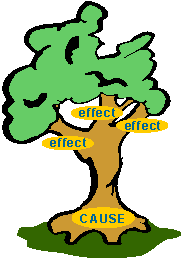
Although most people think that an action produces an equal consequence, that is not true. A tiny seed grows into a plant many times larger, which produces more seeds and more plants. Thus, the original action—the seed—produces truly awesome results. Likewise, our actions develop consequences that are greater than the action.
A very simple example is to imagine throwing a stone into a pond. Most people think of cause and effect as merely being the relationship between the throw and the splash of water. Yet, when analyzed, there is much more occurring. The energy required to throw a stone is rather small, yet the impact of the stone results in a distribution of energy that is far, far greater than the original expenditure of energy. The splash is but the result of the initial impact of the stone on the water. But what about the waves created by the impact? On a still pond, the waves can extend for a very long distance, disturbing the entire pond; not just on the surface, but also towards the bottom, as well as any fish, plants, or other organisms, who might be terrified or disturbed. Moreover, such an action is not limited to just the material consequences; the sound also travels a long distance and creates an impact in a wide area.
Correspondingly, every action we perform has waves of impact that flow both outward and inward. Every action we perform also affects us inside, psychologically.
Numerous psychological problems (inside of us) are caused by the cumulative results of negative actions we performed externally. Yet, because we have never learned to pay attention to our actions and their effects, we are deeply ignorant of the full power of our actions.
The consequences are always greater than the action. This is true for negative actions and positive ones. If we plant the seeds of nourishing fruit, we can feed many people, for generations. Yet if we plant the seeds of selfishness, anger, or lust, we can originate harm on a scale that we can scarcely imagine.
How much greater the effects are than the originating action depends upon the conditions surrounding the action. A word spoken in solitude does not have much effect. But the same word spoken at just the right moment, in the right place, can change the world. In every case, the power of an action is determined by the conditions that surround it. Thus, it is necessary to not only contemplate well the type of action we want to perform, but the precise conditions needed to facilitate it. For instance, many people attempt to educate their children by relentlessly stating the same instructions over and over, yet the child continues to ignore the advice. To truly influence a child in the right way, those words could be spoken one time, if one knows the precise moment to do so.


Leave a Reply